Amazon Affiliate Marketing 2026
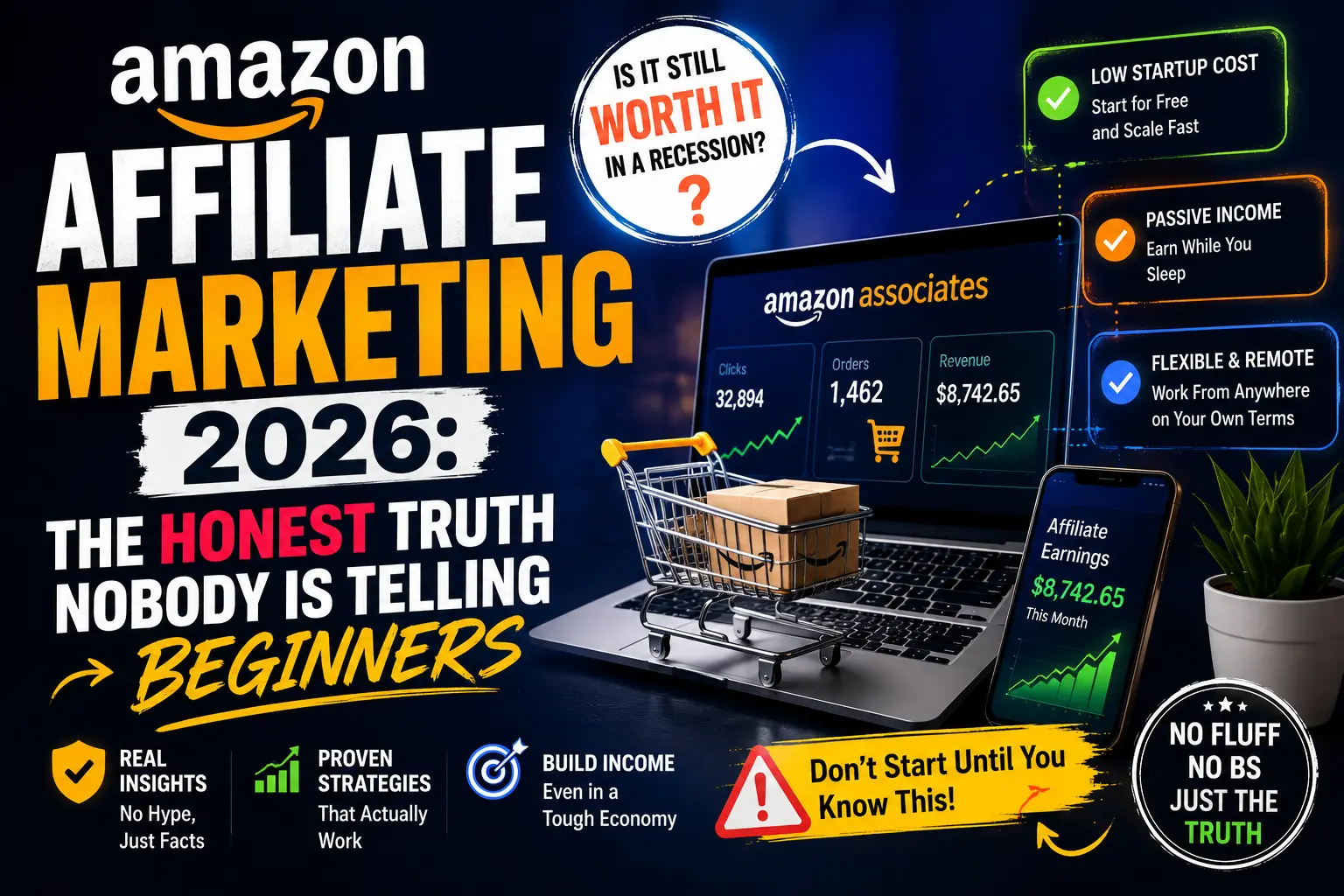
Sarah spent four months building a "niche website" about kitchen gadgets. She followed every tutorial she could find, posted 30 articles, joined Amazon Associates, and waited. Four months later her total earnings? $11.42.
She wasn't doing it wrong. She was doing it the way everyone teaches it. That's the problem nobody wants to talk about.
Here's what the affiliate marketing gurus won't tell you: Amazon affiliate marketing with physical products alone is one of the hardest, slowest ways to build real online income in 2026. The commissions are thin, the competition is brutal, and Google updates have wiped out thousands of review sites overnight.
But here's what they also won't tell you — Amazon affiliate marketing with digital products is an entirely different game. Higher commissions, lower competition, and buyers who are already primed to spend. This guide is about that version. The honest version. The one that actually builds income worth talking about.
If you're serious about building real income streams online, this complete guide to building multiple income streams online will give you the bigger picture of where Amazon affiliate fits into a sustainable strategy.
What Amazon Affiliate Marketing Actually Is in 2026
Amazon's affiliate program — officially called Amazon Associates — lets you earn a commission every time someone clicks your unique link and buys something on Amazon. You don't hold inventory, you don't handle shipping, you don't deal with customer complaints. You simply send people to Amazon and collect a percentage of whatever they spend.
Sounds simple. And it is, in theory. The problem most beginners run into is that they focus entirely on physical products where Amazon pays commissions of 1% to 4%. Promote a $30 kitchen gadget and earn $0.90 per sale. You'd need to drive hundreds of sales per month just to make a meaningful income. That's a lot of traffic for very little reward.
The smarter play in 2026 is digital products. Amazon's digital catalogue has exploded — Kindle ebooks, Audible audiobooks, Amazon Music, Prime Video channels, software subscriptions, online courses, and Amazon's own digital services. These carry commission rates of up to 20%, and they convert at a higher rate because there's no shipping wait, no physical product to doubt, and no returns to worry about.
Physical product affiliates compete with millions of review sites, price comparison tools, and Amazon's own search results. Digital product affiliates compete with almost nobody — because almost nobody is teaching this angle. That gap is your opportunity in 2026.
Why Digital Products Are the Real Amazon Affiliate Opportunity
Let's be brutally honest about the numbers. If you promote a $200 physical camera on Amazon at a 3% commission rate, you earn $6 per sale. You'd need 167 sales per month to make $1,000. That requires serious traffic, which takes serious time to build.
Now compare that to promoting an Audible membership at a $5 to $10 bounty per new signup, or a Kindle Unlimited subscription at a fixed commission per trial. The conversion rates are higher because people already trust Amazon's digital services, the price point feels low-risk, and there's instant gratification — no waiting for a package.
One successful Audible content creator with 10,000 monthly readers can generate $3,000 to $5,000 per month purely from Amazon digital commissions. That same traffic pointing at physical product reviews might generate $300 to $500. Same audience, same effort, completely different income.
How to Actually Start Amazon Affiliate Marketing With Digital Products
Most affiliate marketing guides tell you to "pick a niche, build a website, write reviews." That advice isn't wrong, it's just incomplete. Here's the full picture of what actually works for digital product affiliate marketing on Amazon in 2026.
Go to affiliate-program.amazon.com and sign up for a free Amazon Associates account. You'll need a website, blog, YouTube channel, or social media account with some existing content. Amazon reviews your application within 24 to 48 hours.
Important: Amazon requires you to make at least 3 qualifying sales within 180 days of approval or your account gets closed. Don't sign up until you have a content platform ready to send traffic. Build first, apply second.
This is where most people go wrong. They build a generic "Amazon product review" site and wonder why nobody visits. The winning approach in 2026 is building authority around a specific topic and recommending digital products as a natural part of that content.
Examples that work exceptionally well for digital Amazon affiliate income:
A personal finance blog that recommends books on budgeting, investing, and wealth-building (every book recommendation is an affiliate link). A self-improvement YouTube channel that recommends Audible and specific audiobooks at the end of every video. A book review newsletter that links every book mentioned directly to its Amazon Kindle or Audible version. A productivity blog that reviews digital tools and software available through Amazon.
The pattern is the same across all of these: content that genuinely helps people, with digital product recommendations that feel natural rather than forced.
Resource pages are the highest-converting affiliate content on the internet. A single page titled "The 15 Best Books on Making Money Online" with Amazon Kindle and Audible links for every book can generate passive commission income for years after it's published.
Why this works so well for digital products: People who land on a "best books" page are already in buying mode. They're not casually browsing — they're actively looking for their next purchase. The click-to-buy conversion rate on these pages is dramatically higher than standard review content.
Build one definitive resource page per major topic in your niche. Update it annually to keep it ranking. That's it. Simple, scalable, and genuinely useful to your readers.
YouTube is the most underused platform for Amazon affiliate marketing with digital products. A video titled "5 Audiobooks That Changed My Financial Life" with Audible affiliate links in the description can generate commissions for two to three years after it's uploaded.
The evergreen advantage: Unlike blog posts that depend on Google ranking, YouTube videos compound their views over time. A video that gets 200 views per month in year one might get 800 views per month in year three as it accumulates watch time and algorithmic trust. Your affiliate income grows without you creating new content.
You don't need a fancy setup. A smartphone, good lighting, and genuine recommendations are all you need to start. The authenticity of real recommendations outperforms polished promotional content every single time.
Every platform can change its algorithm overnight. Google can tank your rankings. YouTube can suppress your videos. But nobody can take your email list away from you. An email list of 2,000 engaged subscribers interested in books, self-improvement, or personal finance is worth more than 50,000 social media followers when it comes to Amazon affiliate conversions.
Build your list from day one. Offer a free resource — a reading list, a digital download, a mini-guide — in exchange for an email address. Then send weekly or bi-weekly emails with genuine recommendations, always including your Amazon affiliate links naturally within the content.
A well-nurtured list of 3,000 to 5,000 subscribers can generate $1,500 to $3,000 per month in Amazon digital commissions alone, with the right content strategy and consistent sending schedule.
Physical vs Digital: The Honest Comparison
| Factor | Physical Products | Digital Products |
|---|---|---|
| Commission Rate | 1% — 4% | 5% — 20% |
| Competition Level | Extremely High | Low to Medium |
| Content Lifespan | 6 — 12 months | 2 — 5 years |
| Conversion Rate | Medium | High |
| Return/Refund Risk | High | Very Low |
| Cookie Duration | 24 hours | 24 hours |
| Income Potential | $500 — $2,000/month | $1,500 — $8,000/month |
The one thing nobody tells you about Amazon's 24-hour cookie: When someone clicks your Amazon affiliate link, you earn a commission on everything they buy within the next 24 hours — not just the product you linked to. Someone clicks your Audible link, decides not to subscribe, but then buys $300 worth of electronics while browsing Amazon? You earn commission on all of it. This "cart effect" means your actual earnings are often higher than you'd expect from the product you're promoting directly.
The Mistakes That Kill Most Amazon Affiliate Beginners
After studying what separates successful Amazon affiliates from the ones who quit after three months, the same patterns appear over and over. Avoid these and you're already ahead of 80% of people who try this.
- Promoting everything instead of something specific. "I'll link to every Amazon product I mention" sounds efficient. It's actually a conversion disaster. Focus on one category of digital products and become the go-to recommendation source for it.
- Hiding affiliate disclosures. Amazon requires clear disclosure that you earn commissions. More importantly, your audience trusts transparent creators more than they trust ones who hide the relationship. Disclose clearly and your conversions actually go up, not down.
- Creating content for Google instead of for people. The sites that survive algorithm updates are the ones that genuinely answer questions and recommend products they've actually consumed. Write for your reader first. SEO is a byproduct of genuine helpfulness.
- Giving up before month four. Amazon affiliate income is slow to start and fast to compound. Most people quit at month two when they have $23 in commissions. The ones who reach month six almost always have $300 to $800. The ones who reach month twelve almost always have $1,500 to $3,000. Time is the variable most people refuse to give it.
- Ignoring their email list. Your Amazon affiliate link in an email to someone who already trusts you converts at 3x to 5x the rate of the same link on a blog post to a cold reader. Build the list from day one, not after you've already got traffic.
Realistic Income Timeline for Amazon Affiliate Marketing
Here is what a realistic income progression looks like for someone starting Amazon affiliate marketing with digital products from scratch in 2026, publishing consistently and building an email list from month one.
| Timeline | Expected Monthly Income | What's Happening |
|---|---|---|
| Month 1 — 2 | $0 — $30 | Building content, zero traffic yet |
| Month 3 — 4 | $30 — $150 | First Google rankings, trickle of traffic |
| Month 5 — 6 | $150 — $500 | Content compounding, email list growing |
| Month 7 — 9 | $500 — $1,500 | Consistent traffic, list converting well |
| Month 10 — 12 | $1,500 — $4,000 | Authority established, passive compounding |
These numbers assume consistent publishing (two to three pieces of content per week minimum), active email list building from month one, and genuine focus on digital product recommendations rather than physical products. People who post occasionally and have no email strategy typically earn 10x less at each stage. Consistency is not optional — it is the entire strategy.
Frequently Asked Questions
Amazon affiliate marketing in 2026 is not dead. It's just different. The people who are still chasing thin commissions on physical product reviews are fighting a losing battle against algorithm updates, price comparison tools, and AI-generated review sites. The people who pivoted to digital products — Audible, Kindle, Prime channels, software — are building income streams that compound quietly in the background while they sleep. Sarah's $11.42 wasn't a failure of effort. It was a failure of strategy. Now you have the right one.