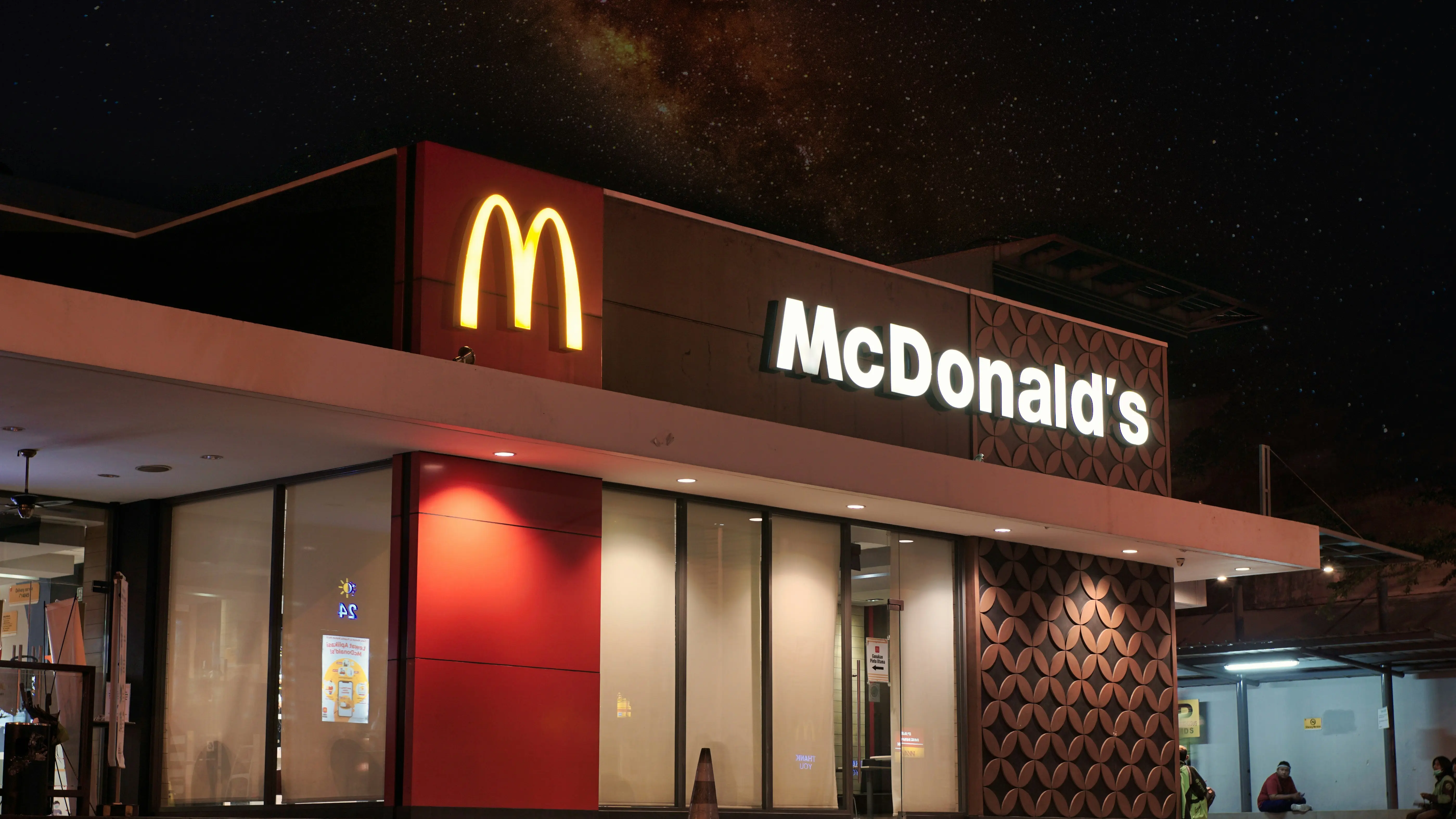
The next time you pull up to a McDonald's drive-thru, you might not be greeted by a human voice. McDonald's has officially launched ArchIQ — an AI-powered ordering system built in partnership with Google — and it is already being tested at locations across the United States. This is the most significant technology upgrade in the chain's history, and it is happening right now in 2026.
Here is everything you need to know: what the system does, why McDonald's is betting billions on it, what it means for customers and workers, and where this is all heading by 2027.
What is ArchIQ and what does it actually do?
ArchIQ is McDonald's new AI-powered operating system developed in partnership with Google Cloud. At its core, it includes a voice-activated assistant — nicknamed "Archy" — that takes drive-thru orders in both English and Spanish without any human crew involvement. Think of it as a highly trained virtual cashier that never gets tired, never mishears your order, and never has an off day.
A franchisee recently posted a live demo of Archy on X (formerly Twitter), showing the system handling a real order smoothly — switching between English and Spanish mid-conversation without hesitation.
Where is it being tested right now?
As of June 2026, ArchIQ is live at five McDonald's locations across the United States as part of a controlled pilot. McDonald's announced the initiative at its Worldwide Convention in Las Vegas under a broader strategy called McDonald's Next — a sweeping plan to reimagine menu, restaurant design, customer engagement, and staffing all at once.
According to a franchisee who goes by McFranchisee on social media, the plan is for every McDonald's in the US to receive a technology upgrade in anticipation of a full ArchIQ rollout — with completion projected by 2027.
Why is McDonald's doing this now?
The timing is not accidental. McDonald's operates more than 40,000 locations worldwide and serves roughly 68 million customers every single day. In the US alone, drive-thrus account for approximately 70% of total sales. Even a small improvement in speed or accuracy at that scale translates to hundreds of millions of dollars in additional revenue.
There are also serious staffing pressures. Brian Rice, McDonald's Chief Information Officer, put it plainly: "We have customers at the counter, we have customers at our drive-through, couriers coming in for delivery, delivery at curbside. That's a lot to deal with for our crew. Technology solutions will alleviate the stress."
McDonald's CEO Chris Kempczinski has echoed this, saying the Google partnership is focused on finding the best ways to use AI to deliver a better experience for both customers and crew members.
How does the Accuracy Scales feature work?
Wrong or incomplete orders are one of McDonald's biggest customer complaints — and with 68 million orders processed daily, even a tiny error rate adds up fast. The solution is elegant in its simplicity.
Every bag is weighed before it is handed to the customer. The AI system already knows the expected weight of a complete order based on what was purchased. If the actual weight does not match the target, crew members are immediately alerted to check the bag before it leaves the window. No scanning, no visual confirmation — just real-time weight data compared against the order record.
How does the Google partnership work?
McDonald's and Google Cloud have built an Edge Computing infrastructure — hardware installed directly inside thousands of restaurants that allows AI to process data locally, without depending entirely on cloud connections. This means the system works in real time even during internet slowdowns.
| Feature | What It Does |
|---|---|
| Edge Computing | Local AI processing inside each restaurant for real-time speed |
| Dynamic Menu Boards | Adjusts displayed items based on time, inventory, and demand |
| Predictive Maintenance | Flags kitchen equipment likely to fail before it breaks down |
| Global AI Hub (Poland) | Handles data management, dynamic pricing, and sales forecasting |
What happened with the previous AI attempt?
This is not McDonald's first try at AI-powered ordering. The company previously ran a high-profile pilot with IBM at drive-thrus across multiple US locations. That experiment was quietly shut down in 2024 due to poor performance — the system struggled with accuracy on complex or customized orders, and customers grew frustrated.
The 2026 ArchIQ system learns from that failure directly. It uses better training datasets, multilingual support, and a human-AI hybrid approach that keeps crew members in the loop rather than cutting them out entirely. The goal is not to replace people at the window — it is to reduce cognitive load on workers so they can focus on food quality and service.
Will this affect McDonald's prices?
Potentially in a positive way. McDonald's has signaled that AI upgrades could help cut operating costs in multiple areas — equipment downtime, labor inefficiency, food waste from wrong orders — which may slow down future price increases for customers. No price cuts have been promised, but the company has suggested that technology savings could help stabilize the menu pricing that frustrated many customers over the past few years.
Will AI replace McDonald's workers?
This is the question on everyone's mind, and the honest answer is: not immediately, but the direction is clear. For now, McDonald's frames ArchIQ as a tool to support workers, not replace them. Crew members are still needed to prepare food, manage the kitchen, handle exceptions, and deliver orders.
However, the longer-term picture is harder to ignore. McDonald's already opened a pilot location in Fort Worth, Texas featuring an app-only drive-thru, conveyor belt food delivery, and minimal customer-facing staff — a preview of where the technology is eventually headed.
McDonald's hopes the AI upgrades will help grow its base of loyal customers from 175 million to 250 million by 2027 — more efficiency means more customers served per hour, with or without proportional increases in staffing.
What does this mean for the wider fast food industry?
McDonald's is not alone. Wendy's, Taco Bell, Checkers, and several other chains have all been testing AI ordering and kitchen automation. But McDonald's scale makes its moves uniquely significant. When the world's largest fast food chain commits to a nationwide AI rollout, it sets a new baseline expectation for the entire quick-service restaurant industry.
Competitors are watching ArchIQ closely. If the pilot succeeds — better accuracy, faster times, higher satisfaction — expect every major chain to accelerate its own AI roadmap within 12 to 18 months.
McDonald's Next: The bigger picture
McDonald's Next is the company's umbrella initiative to modernize every aspect of the customer experience by 2027. ArchIQ is just one piece:
- Multi-lane drive-thrus that serve multiple vehicles simultaneously to cut queue times
- Ready on Arrival ordering expanding to more markets — food ready the moment you pull in
- AI-powered personalization that tailors menu suggestions based on past orders
- Internet-connected kitchen equipment communicating with the ordering system in real time
- Redesigned restaurant layouts built around digital-first customer flows
Conclusion: The drive-thru will never be the same
McDonald's ArchIQ is the most serious AI bet in fast food history, and it is already in motion. With a Google-powered voice system, bag-weighing accuracy technology, predictive maintenance tools, and a nationwide rollout on the horizon, the drive-thru experience is about to change fundamentally — for customers and workers alike.
Whether you see this as exciting innovation or a worrying sign of automation's reach into everyday jobs, one thing is clear: the fast food industry will look very different by 2027. McDonald's is making sure it leads that change rather than reacts to it.
The next time Archy takes your order, remember — you are watching a billion-dollar tech bet play out one drive-thru at a time.